


PU Foam Roller Shutter Door Roll Forming Machine
A PU foam roller shutter door roll forming machine produces insulated rolling shutter slats in one continuous line: the aluminium coil is roll formed into the slat profile, high-pressure polyurethane is injected into the cavity, the foam cures inside a heated tunnel, and a flying saw cuts the finished slat to your required length. One coil in, insulated slats out — no second lamination step, no separate foaming workshop, no re-handling of finished profiles.
This line is built for door manufacturers and slat suppliers who want to control their own supply of insulated shutter slats instead of buying imported panels. The standard configuration runs 0.6 mm aluminium coil at about 15 m/min, forms a 95 mm slat, and holds the cut length to ±1 mm. Profile width, slat shape, hole positions and foam density are made to your drawing.
Technical Parameters at a Glance
| Applicable material | Aluminium coil (galvanised / prepainted steel on request) |
| Material thickness | 0.6 mm (other thickness on request) |
| Feeding width | Per your profile drawing |
| Finished slat width | 95 mm (55 / 77 mm or custom) |
| Forming stations | 40 stations incl. 5-roller straightener |
| Roller material | Cr12MoV, HRC 58–60, chrome plated |
| Shaft | 45# steel, φ55 mm, tempered |
| Main motor power | 15 kW |
| Working speed | About 15 m/min |
| Transmission | Gear box drive |
| PU foam density | 40–60 kg/m³, closed cell, adjustable |
| Foaming system | High-pressure A/B component injection |
| Cutting | Flying saw, non-stop, ±1 mm |
| Hydraulic power | 4 kW |
| Control system | Delta PLC + HMI, Omron encoder |
| Power supply | 260V/60Hz/3Ph or customised |
| Decoiler | 2-ton manual, coil ID 450–550 mm, OD 1500 mm |
| Run-out table | 3 m |
| HS code | 8455221000 |
| Shipping | Nude packing, 1 × 40GP |
One-Pass Forming and Foaming: Why It Matters
Insulated shutter slats can be made in two ways. The slow way is to form the profile on one machine, stack it, move it to a foaming jig, inject foam, wait for curing, then cut — four handling steps, four chances to bend or scratch the finished surface. The fast way is this line: forming, foaming, curing, straightening and cutting all happen on one continuous path.
Handling. On an in-line system the coil goes in at one end and cut slats come out at the other; nothing is transferred between forming, foaming and cutting. On a separate setup every slat is stacked, moved and re-clamped before it reaches the saw.
Surface quality. Chrome-plated rollers and a short, supported transfer keep the coating unmarked. Each manual move on a separate line adds another chance of scratches, dents and fingerprints on the face the customer will see.
Dimensional stability. Support belts inside the curing tunnel hold the profile while the foam expands, and the straightener removes the twist that expansion creates. Foam left to expand freely in a jig bows the slat and leaves the two ends out of parallel.
Labour and rhythm. One operator enters cut length and quantity on the touch screen and the line runs. A separate setup needs an operator at forming, one at foaming and one at cutting, and its daily output is capped by the number of curing racks and jigs on the floor.
For a door factory the practical difference is repeatability. Every slat leaves this line with the same foam fill, the same straightness and the same cut length, which is what keeps a shutter curtain running quietly in its guide rails years later.
Production Process Flow
Decoiler → Guiding and feeding → Roll forming (main forming stands) → High-pressure PU injection → Curing tunnel → Second roll forming / sizing → Adjusting device → Flying saw cutting → Run-out table
- Decoiling — the 2-ton manual decoiler holds the coil, expands mechanically and releases strip under braking tension.
- Guiding and feeding — double hand wheels straighten the strip and centre it on the roll line.
- Roll forming — 40 stations (including a 5-roller straightener) shape the slat profile progressively; gearbox transmission keeps every stand synchronised.
- PU injection — the high-pressure foaming unit meters polyol (A) and isocyanate (B) at a fixed ratio and injects the mixed liquid into the closed cavity.
- Curing tunnel — a continuous heat-retention tunnel lets the foam expand and cure to a rigid closed-cell structure while support belts hold the profile dimension.
- Sizing and straightening — a second forming section with an adjusting device corrects twist and bow created by foam expansion.
- Flying saw cutting — the hydraulic saw travels with the line, cuts without stopping, and holds length to ±1 mm. Offcuts are eliminated.
- Run-out — a 3 m table receives the finished slat for bundling.
Machine Configuration, Part by Part
Part 1 — 2-Ton Manual Decoiler
Cantilever structure with automatic rotation expanding and a built-in braking device, welded frame. Maximum loading 2 tons, coil inner diameter 450–550 mm (adjustable), coil outer diameter up to 1500 mm.
Part 2 — Roll Forming Machine
Welded sheet frame with wire-cut side panels and a ground machine body. Motor-reducer drive through a gear box, polished and hard-plated roller surfaces, 45# steel shafts (φ55 mm, tempered), Cr12MoV rollers quenched to HRC 58–60 and chrome plated. 40 stations including the 5-roller straightening unit, 15 kW main motor, working speed about 15 m/min.
Part 3 — High-Pressure PU Injection System
The foaming machine mixes polyol and isocyanate at an accurate ratio and injects the liquid into the slat cavity, where it expands to fill the whole section and forms rigid closed-cell PU foam. Density is adjustable between 40 and 60 kg/m³, so you can choose a lighter slat for residential doors or a denser, stiffer slat for large commercial openings.
Part 4 — Curing Tunnel and Straightener
A continuous heat-preservation channel gives the foam time to cure fully. Support belts keep the profile dimension stable while the foam expands, and the straightener removes the twisting and bending that expansion creates.
Part 5 — Hydraulic Flying Saw
Straight hydraulic cutting driven by pillar-type cylinders, GB-Cr12 cutter, length tolerance ±1 mm. The saw is synchronised with line speed, so cutting happens without stopping the line and without generating waste.
Part 6 — Hydraulic Pump Station
A 4 kW station sized specifically for this line, with a cooling fan that keeps oil temperature stable during long shifts.
Part 7 — PLC Control System
Delta PLC and Delta frequency inverter, Omron encoder, touch screen with English and Chinese interface. The operator enters cut length and quantity, and the line runs automatically; the counter stops the machine when the order quantity is reached. Speed, length and batch count are all set from one screen.
Profile, Material and Customisation
The standard tooling on this line produces a 95 mm foamed slat with a punched or non-perforated surface, depending on how the finished door will be used. Because every market has its own curtain system, the line is built around your drawing rather than around a catalogue:
- Slat width — 55 mm, 77 mm, 95 mm or a width defined by your profile drawing.
- Material — aluminium coil as standard; galvanised steel, prepainted steel and stainless steel can be specified.
- Surface — plain, embossed or perforated; punching positions set by tooling.
- Foam density — 40–60 kg/m³ to balance insulation value, weight and cost.
- Cut length — any length within the run-out table range, set on the touch screen.
- Voltage — 260V/60Hz/3Ph or matched to your plant supply.
- Machine colour — customised on request.
Send a profile drawing, a slat sample photo or even a short video of the curtain you want to copy, and our engineers will confirm tooling, stations and line speed before quotation.
Where PU Foamed Slats Are Used
- Shopfront and commercial shutters — insulated slats reduce street noise and keep the shopfront quieter inside.
- Garage and residential doors — foam filling stiffens the curtain and cuts heat transfer, which matters in both hot and cold climates.
- Warehouses and logistics buildings — larger openings need stiffer slats to resist wind load and daily cycling.
- Window shutters and roller blinds — narrow profiles for residential window systems in European and Latin American markets.
- Cold-storage and food processing rooms — denser foam and tighter profile tolerance support insulated door assemblies.
Inspection Before Shipment
Every line is assembled and run with your material before it leaves the factory. We inform you seven days in advance so you or your engineer can attend the test; we prepare the coil, run the profile, check foam fill, measure cut length and record the results. If travelling to China is not practical, we send a full running video and photo set covering the decoiler, forming section, foaming unit, curing tunnel, saw and control screen, and we run a live video inspection on Zoom or WhatsApp at a time that suits you.
Packing, Delivery and Terms
| Packing | Nude packing with protective film, 1 × 40GP container |
| Production time | About 60 working days after deposit and drawing approval |
| Payment terms | 30% T/T deposit, 70% before shipment |
| Installation | About 5 days with two technicians; costs quoted separately |
| Warranty | 2 years whole machine, lifetime technical support |
Related machines: roller shutter door roll forming machine · metal embossing forming machine · hydraulic uncoiler
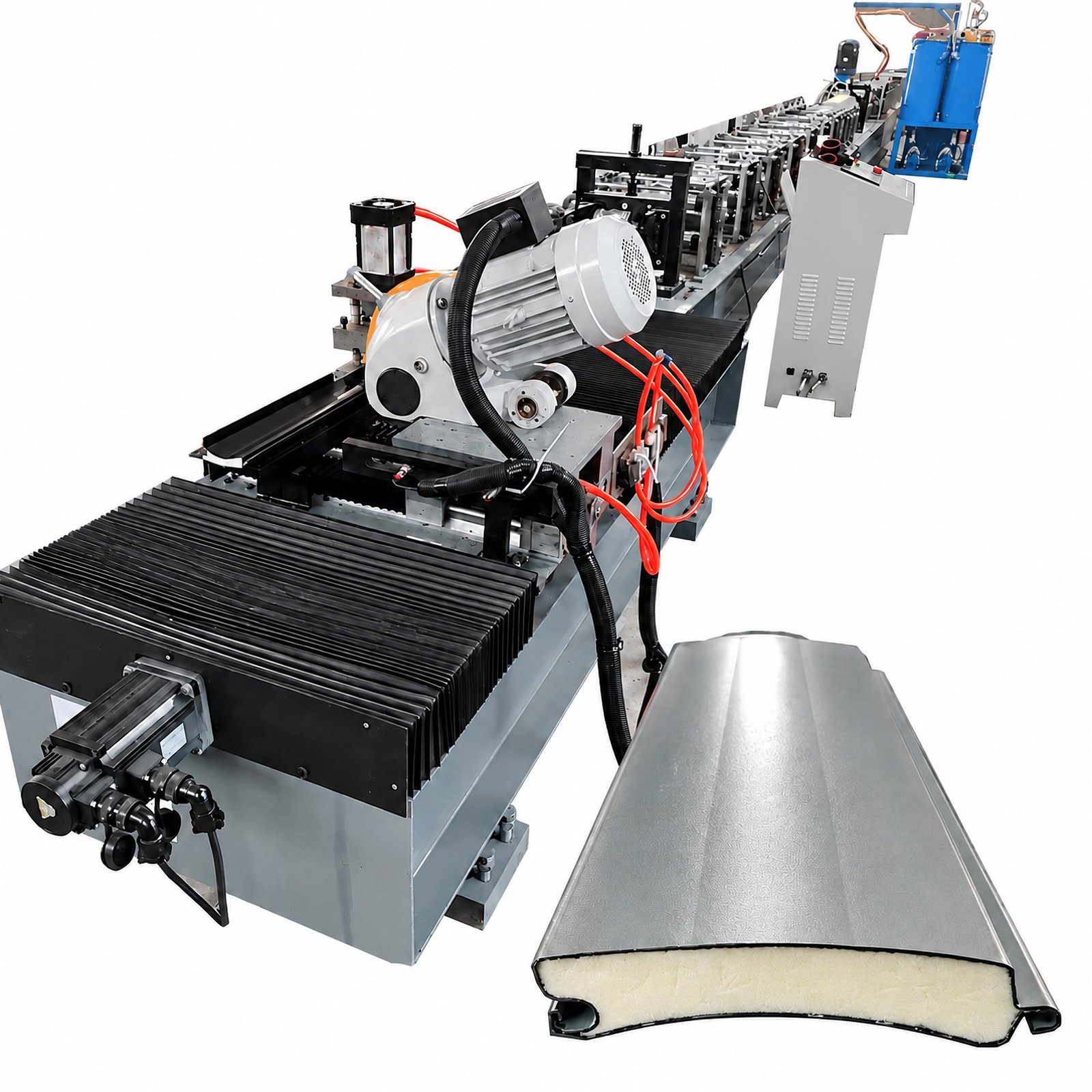
It is a continuous production line that roll forms metal strip into shutter slat profiles, injects polyurethane foam into the slat cavity, cures the foam and cuts the finished insulated slat to length — all in one pass.
Price depends on slat width, number of stations, material thickness, foam density and the control configuration you choose. Send your profile drawing and target output and we will quote a firm FOB price, typically within one working day.
PU foam is injected as a liquid and expands to bond to the slat walls, forming a closed-cell structure that adds stiffness as well as insulation. EPS inserts are pre-cut blocks pushed into the cavity, which leaves gaps, adds handling and gives a lower stiffness-to-weight ratio.
Yes. Each slat width needs its own roller set. Many customers start with one width and add tooling later; the frame and drive are designed to accept additional roller sets.
Aluminium coil is standard. Galvanised steel, prepainted steel and stainless steel can be run with the appropriate tooling and thickness range.
At about 15 m/min, a single shift produces roughly 5,000–6,000 running metres of finished slat after allowing for coil changes and normal stops. Exact figures depend on slat length and operator routine.
About 60 working days after deposit and drawing approval, shipped as one 40GP container with nude packing. HS code 8455221000.
Two-year warranty on the whole machine, lifetime technical support, spare parts supply, and optional on-site installation and training by two technicians, usually completed in five days.
Yes. Send a drawing or a sample slat and our engineers will design the roller set, confirm stations and speed, and issue a profile drawing for your approval before production.